For your lawyer
What governs the election, and what we produce against each requirement.
Board elections, bylaw votes and AGMs for professional bodies. Configured from your own electoral regulations, run remotely or hybrid, and closed with the documents and the certificate that prove the result.
Free account, no credit card.
Professional bodies that vote with Vocdoni




A board election is judged twice: by the members who did or did not take part, and, if somebody objects, by a court. Both judgments land on the same desk, and so does the bill.
A member practising two hours away will not travel for a two-hour assembly. Turnout stays low, and a board elected by a small fraction of the roll governs with an argument already made against it.
What changes with Vocdoni
Voting takes two minutes from any device, so the members who never travelled now take part.
A candidate asks your electoral board how it knows the number is right. Today the honest answer is that the provider said so. Nobody wants to sign their name to that.
What changes with Vocdoni
The count is published with the record it was counted from, so your board checks it before signing rather than after.
Printing, postage, the room, the staff hours and a count that runs past midnight. Every cycle, and the cycle after that.
What changes with Vocdoni
A fraction of that, and next time you reopen this year's setup instead of rebuilding it from memory.
Digitizing our voting with Vocdoni has made the entire electoral process more efficient. We have made participation much easier, especially for members who could not travel, while maintaining an agile and reliable system.
President · Official College of Nursing of Seville
COIB, the official college of nurses of Barcelona, ran its 2025 AGM with a one-time code on every vote, members voting from the room and from home, and the count published at close.
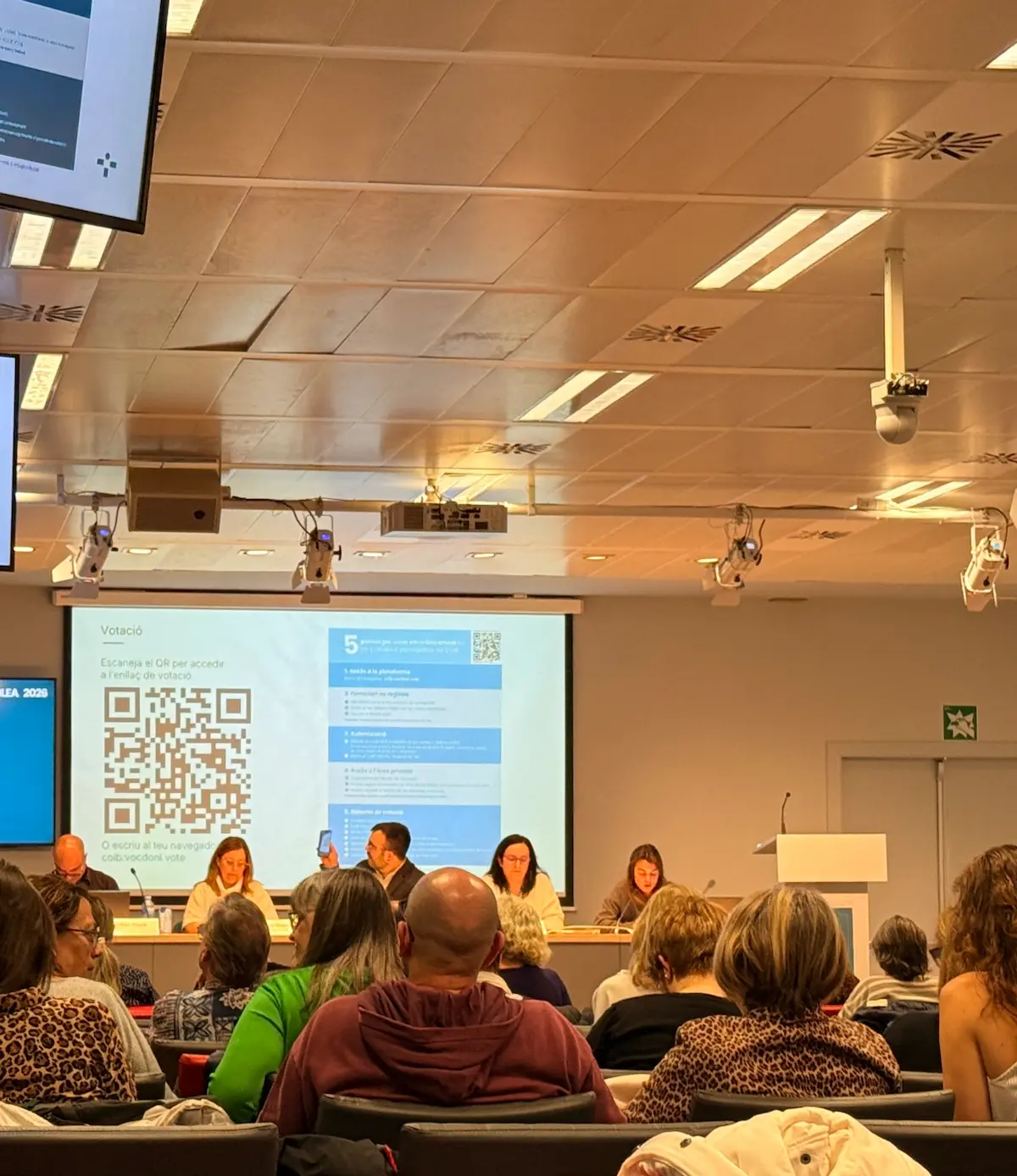
COIB, Col·legi Oficial d'Infermeres i Infermers de Barcelona
Professional body, Barcelona, 2025, hybrid annual general meeting
“At the Official College of Nurses of Barcelona, we trust Vocdoni for all our participatory processes, ensuring members can exercise their rights from anywhere. We especially value the immediate vote count, the simplicity of the system, and the fast, effective response and guidance from its technical support, which makes the entire process agile, transparent, and reliable.”
Lluis Serrat i Andreu, Head of projects · Official College of Nurses of Barcelona
The two questions that decide whether this reaches your governing board. Your own statutes and electoral regulations sit above everything below: they are the document we configure from. Ask us for the version of this section that applies in your country.
Whatever your statutes require, a remote ballot has to show that the rules were fixed in advance and then followed. Decisions improvised during the vote are what challenges are built on.
What you get against it
A count that nobody outside the room can check is a count that has to be believed. When your decisions can be appealed, belief is not enough.
What you get against it
A member has to be able to vote against the sitting board without anyone finding out. Including your own staff.
What you get against it
The electoral roll is personal data. Minimisation, retention limits, a processing agreement and a lawful basis are all required, and the trail has to survive the election.
What you get against it
The whole process is verifiable from end to end, and on the day voting closes you get the file that proves it. It holds the signed configuration, a sealed copy of the electoral roll at the cut-off date, the turnout log, the published count and the instructions for checking it, together with a report and a certificate of the process for your minutes. It is built for somebody hostile to the result: an auditor, a losing candidate or their adviser can check every part of it without needing anything from you, or from us.
We state the framework as we understand it and produce the evidence above; the legal reading of your own statutes belongs to your counsel.
These are the capabilities that get cited when a process is questioned, and the member experience they produce.
Seats, sections, eligibility rules, cut-off dates and tie-breaks follow your own text. We read it before configuring anything.
At the statutory cut-off date the electoral roll is locked and sealed with a short code that changes if a single name is added or removed. A dispute about who was entitled to vote takes a minute to settle.
The electoral board sees turnout as it happens and gets the certified export directly. No access to individual votes, and nobody can say the numbers passed through your office first.
Most bodies run the whole election remotely. If you want a room as well, members can vote at an assisted point in your offices on the same day. Both routes use the same electoral roll, so nobody votes twice.
Identity and ballot are kept apart by the system itself, not by a promise anyone could break. Nobody can put them back together: not your staff, not the electoral board, not Vocdoni.
The configuration is saved and reopened for the next election, instead of being rebuilt from memory and last cycle's folder.
Email or SMS with your own branding, the agenda, the candidates and the exact window in which voting is open.
A one-time code by SMS or email confirms this is the member on the roll. No account to create, no app to install, no membership number to look up.
Board seats, bylaw amendments and budget approvals, each with its own majority rule, on one screen with the supporting documents attached.
They keep a receipt nobody else has. When voting closes, they can confirm their own vote was counted in the published result.
Most members finish in under two minutes, in the browser they already have open. If part of your roll is genuinely offline, the assisted point runs on the same electoral roll, so nobody is excluded and nobody votes twice. The obstacle is almost never the member: it is a missing mobile number in your database. So we check your contact details before anything opens.
Offering members a secure and reliable voting system is essential, especially during a pandemic. Vocdoni gave us an easy-to-use tool that simplified the voting process and boosted participation.
Secretary · Associació d'Arxivers de Catalunya
A statutory election is planned backwards from a date you do not control. This is the shape of it.
6 weeks out
You send us your statutes and electoral regulations. We come back with what we can run as your rules stand, and what needs a decision from you.
You and us
4 weeks out
Eligibility, cut-off date, quorum, majority rules and the voting window are written down and signed off before anything is built.
Your electoral board
3 weeks out
Your membership database becomes an electoral roll, validated against your own criteria. This is where missing mobile numbers surface, while there is still time.
Us
2 weeks out
The real configuration with test voters. Your electoral board walks the process and your staff practise on the console before a single member is invited.
Both teams
Voting day
Live turnout for the electoral board, a support line for members, and the count published when the window closes. The documents and the certificate follow the same day.
Us, on call
A simple internal vote can be live the same week. This schedule is for a statutory election under an electoral board, and most of it is your approvals rather than our configuration.
Against what your last electoral cycle actually cost you, and against what a commercial provider hands you at the end. We name no one: this is the shape of the category.
Same platform, same guarantees, same evidence at the end. Most bodies take the managed service for the statutory election and use the same subscription themselves for everything else during the year.
Create, configure, launch and close your own votes whenever you need them. One person, one afternoon, no IT team, with training and a support channel behind you.
We read your electoral regulations, configure the process, load and validate the roll, run a full rehearsal with test voters, monitor the voting day and deliver the results, the reports and the evidence pack. You approve, we operate.
There is a free plan with no time limit and no card, and paid plans are priced by the number of members. Those prices are published, so you can see where it starts without booking a call. Managed elections, customisation and anything else you need on top are quoted per election, on the size of your roll and what the process involves. See where pricing starts (opens in new tab)
The platform is the same at every size. What changes is how much of it you need and how much we do with you.
Up to about 1,000
You do not need a project. One person creates the vote, uploads the roll and sends the link, on the free plan or a small subscription.
A few thousand
The shape most professional associations are. Self-serve or managed depending on what you need: how much you want customised, which extra services you want, or simply which parts you would rather hand to us.
Tens of thousands
The platform is the same one the smaller bodies use. What changes at this size is how much you want us to take on: customisation, running the process for you, and people in the room on the day.
The questions your governing board will raise, answered here so you have the answer before they ask.
You will not decide this alone. Each of these answers one person in the room, and each has its own link you can send them.
What governs the election, and what we produce against each requirement.
What they can see on the day, and what they get to certify against at the close.
What it costs, and how the two ways of working with us differ.
How this compares with the process you run today, line by line.
The most useful first conversation is not a demo. Send us your electoral regulations and we will tell you what is configurable as written, what needs an electoral board decision and what would need a statutory amendment. If the answer is that you should not take this election online yet, we will say so.
Free account, no credit card. No sales pitch, just answers.
Guides, explainers and case studies that answer the question you are probably about to ask.
case study
A nursing college, a one-time code on every vote, members voting from home or in the room, and travel costs removed.
guide
A practical checklist for a digital or hybrid annual general meeting.
guide
What data protection law expects when you take a vote digital.
guide
How quorum is calculated and tracked when members vote remotely.
explainer
Why anyone can check a result without having to trust the platform.
guide
The real risks in a remote ballot, and the defences that answer them.